New Mac Virus

There has been a new virus that has been affecting Macintosh computers called (Backdoor_OSX_Morcut).
How the virus is spread is unknown, but there are several symptoms to the symtoms of the virus.


  1. It can take full control on e-mail and chatting option of users.
  2. It can take full control on Skype and MSN ID of users.
  3. It can remove photos that have taken by webcam.
  4. It can pass every login password.
  5. Executive application, browse history, document screenshot, control on microphone, information on calendar, and addresses that have been stored in various ID’s can be controlled because of this Mac virus.

Referring back to my post about internet safety myths this proves that no operating system is safe, even Mac computers who used to be able to boast that their operating system cannot get viruses and have no need for an anti-virus software system. I hope this latest attack busts the myth once and for all.


3 Ways to improve your internet connection

1) Keeping your router in a central location, this simple step is one of the most important steps in ensuring total internet optimization as the router is the central hub for the internet connection and the less resistance that the signal has to go through the stronger your connection will be.

2) Another way to improve the internet connection is to make sure if no other wireless devices interfere with the wireless signal that the wireless router sends out, for example if the router is a 2.4 gHz and if you have other wireless devices that have a similar frequency they may interfere and cause a slower connection speed while both of them are online simulatneously.

3) Another way to maximize your internet connection is to check if anyone else is using your internet connection as your wireless signal can also be detected by your neighbours or other people and to check if anyone is using your wireless internet you can go to Control panel and to the left you will see beside the Network bar the names of every computer that is connected to the internet if you do not recognize some of the computers then someone is using your internet. To prevent this from happening secure your internet with a encryption key such as WEP or WPA with the use of your local router software.


Add-ons to avoid *All browsers*

 Browser toolbar add-ons - These add-ons are just a giant eyesore on the browser, these add-ons usually have nothing new to offer except for a google search bar, some colour customization schemes, social media shortcuts such as facebook or  twitter and some even add advertisements on your page. These tool-bars are also notoriously annoying to uninstall as they always manage to find their way back onto your browser screen.

 Youtube downloader add-ons - On a first impression these add-ons seem to be useful for downloading youtube videos quickly while on the go to put on your phone or ipod, but these add-ons are slow and require constant updates as browsers are regularly updated.

Translation add-ons - These add-ons serve almost no purpose as you get the same result by using google translate if not even better results as these programs are usually outdated verisons of previous translation software and serve only to slow your PC down!


'Money order' scams

As people start to use online advertisement websites to sell their unused merchandise, new scams have been appearing on these websites as individuals attempt to cheat others out of their belongings. A common scam that has been occuring on websites such as eBay, or Amazon is that when users put their auctioned item on the internet, for example a laptop computer some individuals may offer to buy the item by the use of a 'money order cheque'. These cheques may appear to work for the first couple of days, but after a couple of months when you have already shipped the product to the individual that gave the 'money order cheque' the cheque will bounce and you will be asked to pay the difference. This scam occurs mainly to items that are hard to sell, for example used laptops and it relys on the users haste to sell the item to which he will be glad to accept the 'money order' offer.

To protect yourself from this type of scam, accept only paypal or bank transfers as the method of payment as this will allow you to successfully confirm that the money has entered your account before sending off the item to the individual.


Conficker Virus

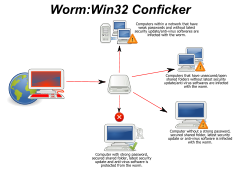
Conficker Virus- This computer virus has infected over 15 million computers to date from its discovery in Early 2008.  This virus expliots a vulnerability in the Windows service programs and causes your computer to download a copy of the virus therby infecting your computer. Your computer can also be used as a base to host future virus attacks on other computers once infected.

Symptoms of the Conficker Virus

- Being locked out User accounts
- Windows services disabled (Windows defender, Automatic Updates)
-Decrease in overall system performance
- Anti-virus systems disabled


To check if your computer has the conficker virus please visit:
http://www.confickerworkinggroup.org/infection_test/cfeyechart.html


Common Internet Safety Myths

Don't believe what everyone tells you these days, there is a lot of speculation these days to regards with  internet safety and most of the rumors that spread around are usually untrue and leave your computer open to malware and viruses.

1) A common myth to regards with internet safety is "Macs don't get viruses" refering to the myth that computers produced by Apple do not get viruses because they run on a different operating system. This is untrue as the Macintosh computers can get viruses just the same as windows computers, but at a lesser rate since viruses and malware are usually designed for the windows operating system.

2) "<Insert browser name here>" is safer than internet explorer". Everybody likes to bash internet explorer these days as it is slow and clunky in comparison to much faster browsers such as Google chrome. The truth of the matter is that each browser have an equal chance of getting infected with viruses and the protection is based upon what anti-virus software you have rather than the type of browser you are using.


3 Things to do after purchasing a new computer

1) Uninstall all of the "bloatware" on your new computer, new computers usually have fast performance so you will usually not notice the decrease in system performance in the short-run, but system performance will suffer in the long run. "Bloatware" on a new computer would be programs that come installed with the computer.

2) Install anti-virus software IMMEDIATELY it is vital that you add protection to your new computer as it is better to be safe than sorry. Just get it out of the way quickly and you won't have to worry about viruses in the future. A recommended anti-virus program would be Avast.

Avast Anti-virus program: www.avast.com

3) Backup your system on a CD. If a virus strikes and you have no way of fixing the problem without bringing your computer to a computer repair shop the usual solution is just to wipe your whole hard-drive and your system will be operational again.

WARNING Java Virus

I thought you guys should be aware that there is virus that infects the java update part of your system and it masquerades as a java update in order to infect your computer.  My laptop has just been infected by this type of virus so I thought it would be helpful to post the different steps to take if others are also infected.

Steps to take if you are infected by the official java website:
SYMPTOMS 

Malicious applets have been discovered in the Java cache directory. Anti-virus programs have detected such malicious applets in the following directory:
C:\Documents and Settings\<username>\Application Data\Sun\Java\Deployment\cache


CAUSE 

Viruses found in this cache directory are not associated with the Java that was downloaded and installed on the system. A cache directory is a a temporary storage location. When the browser runs an applet or application, Java stores files into its cache directory for better performance.
Some examples of the virus reported in the cache directory:

  • Trojan.ByteVerify
  • Pdfjsc.CR
  • Uutecwv.class
  • Hieeyfc.class


SOLUTION 

If you find one of these malicious applets on your computer, please use an anti-virus program to delete the applet, or you can clean the cache directory manually. Follow the below instructions to manually remove these malicious applets from the Java cache directory:

  1. From the Start button, select Control Panel.
  2. In the Control Panel, open the Java Control Panel.
  3. Click on Settings button under Temporary Internet Files.
  4. Click Delete Files button at the Temporary Files Settings window.
  5. Click on OK button at confirmation dialog.

3 common signs that show that your pc has a virus

Well viruses are becoming more commonplace even with the advance in anti-virus software in this age. Viruses linger around in your pc and you may not even know that your computer may have a virus right now.

1) One common sign that your computer has a virus is that the system performance decreases dramatically, for example if your boot-up time slows down considerably it could be that a virus has infected your programs and cause considerable lag time in the boot time.

2) Another sign that you may have a virus is if your computer blinks when you issue a command to the computer, for example when you click the mouse and if the computer screen blinks, you may have a key logger on your computer. A key logger is a program that records your keyboard as you type sensitive information such as personal information such as a bank login and password.

3) Another sign that you might have virus is if your anti-virus software is disabled such as for example,  if essential programs such as windows defender or firewalls are turned off you may have a virus on your computer which allow people to access your computer while your computer protection is disabled.

To counteract these viruses you should scan regularly with a simple full system scan of your computer at least once a week which will allow you to scan for these viruses before major problems arise.


2 EASY ways to Boost Computer Start-up speed

We've all experienced it, slow boot-up on a laptop or desktop and you just want to get your computer started up, but it is taking an eternity to start-up.

1) The easiest way to boost your start-up speed on your computer is just to remove all of the junk off of your computer, things such as temporary cache files, a full recycling bin and downloads that you no longer use. Now this may be a tedious task to do by yourself, but there is a free cleanup program called CCleaner that can help you do this with a push of a single button!

CCleaner download link: http://www.piriform.com/CCLEANER

2) Another way to boost your start-up speed on your computer would be to defragment your computer. What this means is that in your computer there may be many files on the computer that may be broken and fragmented and this will slow down system performance if many of these files are present inside of your hard drive. This can be easily solved by searching for 'Disk Defragmenter' on your windows search bar.